Partner Recognition

Boehringer Ingelheim

October 2022

A decades-long partnership between Georgia’s flagship university and a global leader in human and animal health has improved the lives of students, educators, researchers, farmers, livestock, pets and pet owners. And for UGA and Boehringer-Ingelheim, the work has only just begun.

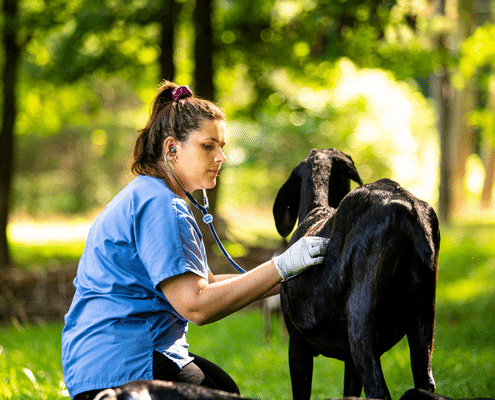
It is morning on a farm in Watkinsville, Georgia, and Leonor Sicalo is in her element—kneeling to scratch underneath a goat’s ears.

To get to this sun-dappled clearing, Sicalo, a Ph.D. student in the University of Georgia’s College of Veterinary Medicine, followed an unconventional route.

She studied and earned a Doctorate of Veterinary Medicine in Uruguay, then moved to Argentina for a residency in animal health. Here, she discovered that not only was there a highly respected UGA professor taking on Ph.D. students in her field—bovine parasitology—but Boehringer Ingelheim, a global pharmaceutical leader based in Germany, had created a bovine parasitology fellowship at UGA.

She applied, she got in and here she is: the culmination of a story that touches three hemispheres. And it is one of many stories co-written by UGA and Boehringer Ingelheim.

A close-knit community

The roots of the university’s relationship with Boehringer Ingelheim—a company many will know best as the maker of pet medications Frontline, Heartguard and NexGard—can be traced back nearly 40 years. 

In the 1980s, animal health company Select Laboratories began a relationship with UGA. Select Laboratories became part of Merial in 1997, and the next 20 years saw a steady strengthening in collaboration between the university and the company, culminating in a Phoenix Award in 2014.

In 2017, Boehringer Ingelheim acquired Merial and merged it with its existing animal health business to create Boehringer Ingelheim Animal Health. Many collaborations might have slowed during such a transition, but UGA and Boehringer Ingelheim didn’t miss a beat due, in part, to an element of the partnership that launched three years prior: a joint steering committee to guide the relationship forward.

“I like to say steering committee meetings are a formal time to talk about informal things: who are the new faculty members at UGA, what new projects are going on at UGA, when might we be able to come to a seminar that could be of relevance to our employees, that sort of thing,” said Rachael Widener, alliance manager and senior associate director of business development for Boehringer Ingelheim’s Animal Health business.

The steering committee also gives both institutions regular opportunities to build up another vital element of the partnership: an earnest camaraderie that creates a close-knit community.

And that close-knit community isn’t just figurative: the company has a significant Animal Health Global Innovation Center in Athens, and the company leases space on UGA’s campus. Having staff and resources nearby makes it easy to build and maintain positive relationships. It also makes collaboration smoother and more productive, whether it’s UGA students interning in Boehringer Ingelheim facilities, company scientists visiting UGA for a seminar or sharing research equipment and materials.

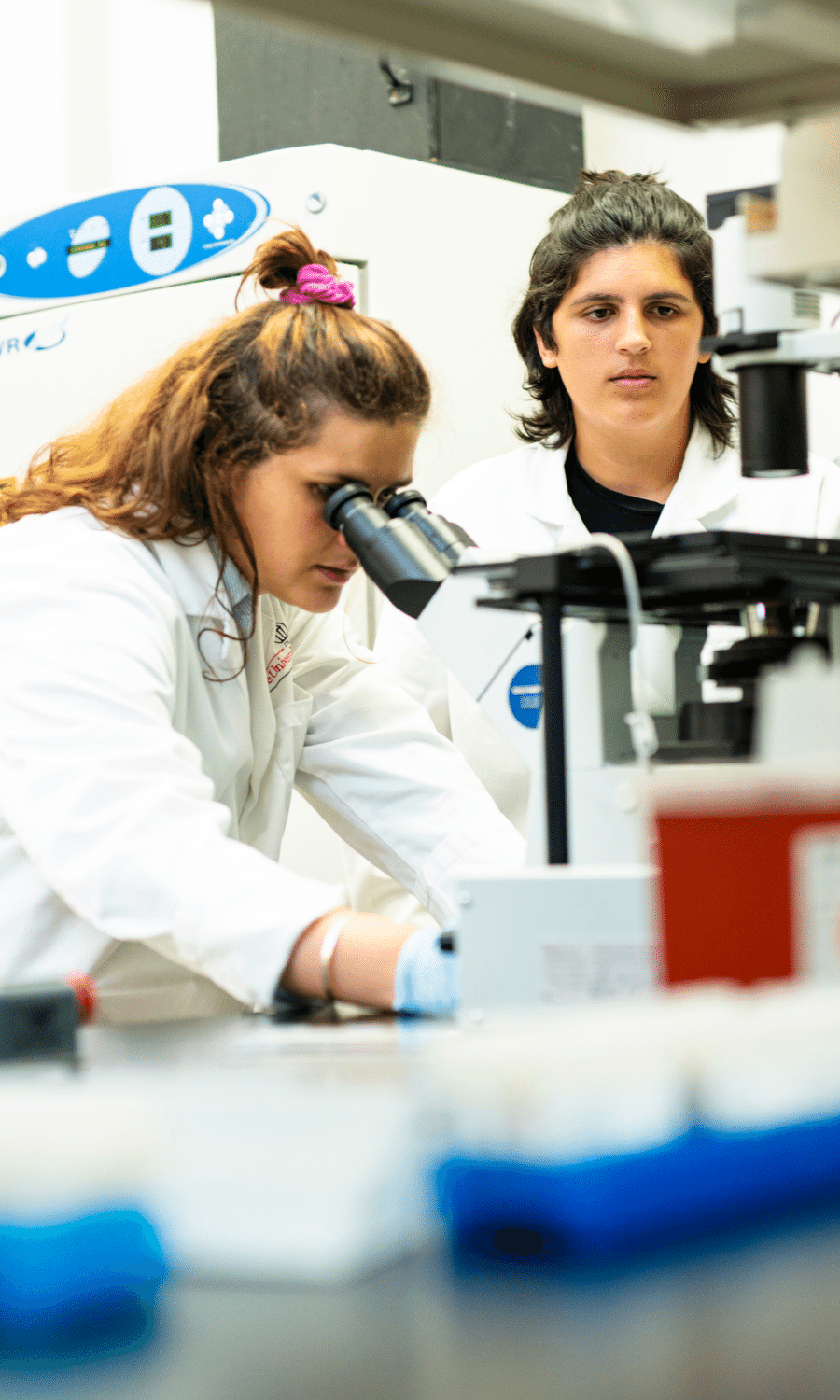
Leonor Sicalo looks into a microscope in a UGA College of Veterinary Medicine lab.

A unique opportunity for all of us to grow

Frane Banovic

Staying connected

For Boehringer Ingelheim, the value in partnering with UGA on the research front isn’t simply that the university boasts exceptional faculty and cutting-edge facilities and resources.

“UGA is attractive to work with because of the diversity of research that goes on,” said Widener. “Traditionally, we interact with UGA on research collaborations and clinical trials in the College of Veterinary Medicine, but we also work with the Center for Vaccines and Immunology and the College of Engineering, and we are hoping to soon start more work with the College of Pharmacy.”

Frane Banovic is an associate professor of veterinary dermatology in UGA’s College of Veterinary Medicine and someone who has benefited significantly from the company’s interest in UGA research.

“My lab focuses on inflammatory skin diseases of animals like dogs, cats and horses,” said Banovic. “These are the most prevalent skin diseases that affect about 25-30% of the dog and cat population at any given time, though the prevalence of these disease is increasing.”

That growing prevalence has been a major concern of Banovic’s lab since his arrival at UGA in 2015. According to Banovic, there is a great need for more precise therapeutics in this field, and Boehringer Ingelheim has been seeking to address this need.

The company has sponsored projects through Banovic and his lab that have led to significant advances in the field, and the funding provided for those projects has enhanced not just the work of the lab, but the people in the lab.

“It’s very important to have funding for our graduate student positions,” said Banovic. “Without that support, graduate students may try to pay for their education by working on the side while trying to complete a master’s or Ph.D. program. Funding allows them to truly focus on the research, which benefits the program and advances the field.”

Similarly, what Boehringer Ingelheim gets from these projects goes beyond knowledge. They are able to scout for new talent among the graduate students working on company-sponsored projects, ensuring that anyone brought on board is familiar with its operations and working in an area of interest to the company.

“We are able to get the funding we need, we are able to get the students we need and they are able to get the results and the talented people they need,” said Banovic. “It’s really a unique opportunity for all of us to grow.”

Investing in the next generation

For decades the company has invested directly in tomorrow’s veterinarians, scientists and leaders.

Leonor Sicalo, the recipient of the Boehringer Ingelheim Animal Health Bovine Parasitology PhD Fellowship, is one such leader. Although she can occasionally be found on a Watkinsville farm, she spends more time in a UGA lab studying intestinal worms in cattle and sheep and their resistance to dewormer treatments.

“In Argentina, I saw that there was a huge gap in knowledge between the lab and the farm, and that encouraged me to pursue parasitology,” said Sicalo. “We need to develop new techniques and new diagnostic tests to make things easier for the farmer who actually has to apply them in the field.”

This problem creates a significant drain on industry—not just in Argentina, but everywhere. According to Sicalo, cattle parasites cost the U.S. beef industry over $2.5 billion every year. She is proud to be a Boehringer Ingelheim fellow because she sees how the company connects those who find solutions and those who implement them.

“Over the past three years, I’ve attended many company-sponsored seminars, bringing together experts  with vets and farmers that are facing challenges,” said Sicalo. “They are creating a bridge between research and farmers, and that’s exactly what we need from the industry.”

The fellowship has allowed Sicalo to engage in significant bridge-building of her own by funding trips for her to connect with colleagues near and far. She recently visited a lab in Scotland that’s doing work similar to hers, and travel to conferences and workshops helped her get elected as a student representative on the American Association of Veterinary Parasitologists’ leadership team.

Individuals like Sicalo are a major reason why Boehringer Ingelheim has made numerous investments developing veterinary and research talent. The Georgia Veterinary Scholars Program, which has provided research experiences to hundreds of veterinary students since 1995, illustrates the history and scale of Boehringer Ingelheim’s support on campus—but even that just scratches the surface.

  • Boehringer Ingelheim has participated in career fairs and industry nights on campus for decades, sponsoring and tabling at university-wide events and engineering, science and veterinary medicine engagements.
  • In 2018, the company helped organize the university’s first Animal Health Hackathon, which saw 100+ UGA students from myriad disciplines develop and pitch innovative solutions for pet and livestock care.
  • Boehringer Ingelheim annually offers internships and co-operative education opportunities. These “co-ops” allow students to take on responsibilities similar to a full-time employee while the company scouts potential hires.
  • The company’s many connections with UGA and its student body have led to the company hiring more than 120 students since 2019.

As those fields evolve, this relationship is going to evolve

Kyle Tschepikow

In April 2022, the company announced a $57 million investment in its Animal Health Global Innovation Center in Athens, an initiative that could open the door to even more opportunities for collaboration between UGA and BI.

“I think that UGA has really grown and evolved over the last few years and our company has grown and evolved over the last few years,” said Widener. “And as we continue to grow and evolve, I think it’s really important to keep each other in mind and grow in partnership.”

Additionally, September 2022 saw the first Boehringer Ingelheim-UGA Partnership Summit, a day-long event that brought together researchers and staff, UGA faculty and students, and leadership from both institutions for panel discussions on poultry, vaccine design and bioengineering.

“In some ways, you could say that the future of this partnership looks like the future of animal and human health: as those fields evolve, this relationship is going to evolve,” said Kyle Tschepikow, UGA’s executive director of business engagement and innovation.

For institutions on the level of the University of Georgia or Boehringer Ingelheim, institutional missions become so lofty that achieving them—or even pursuing them at a satisfactory level—requires an unparalleled commitment to establishing strong partnerships. Complexities intensify as operations scale, and at a certain point, a strong, symbiotic relationship becomes invaluable. 

“We think about a strategic partner as a company that interacts with the university across multiple areas; a company whose mission aligns with our strengths and aspirations; a company that invests in the state of Georgia and can share in our land-grant mission; and a company that is interested in investing in our research, education or our service initiatives,” said Tschepikow.

“Boehringer Ingelheim checks all of the boxes.”

Leonor Sicalo examines a goat at Latimer Luck Acres in Watkinsville, Ga.

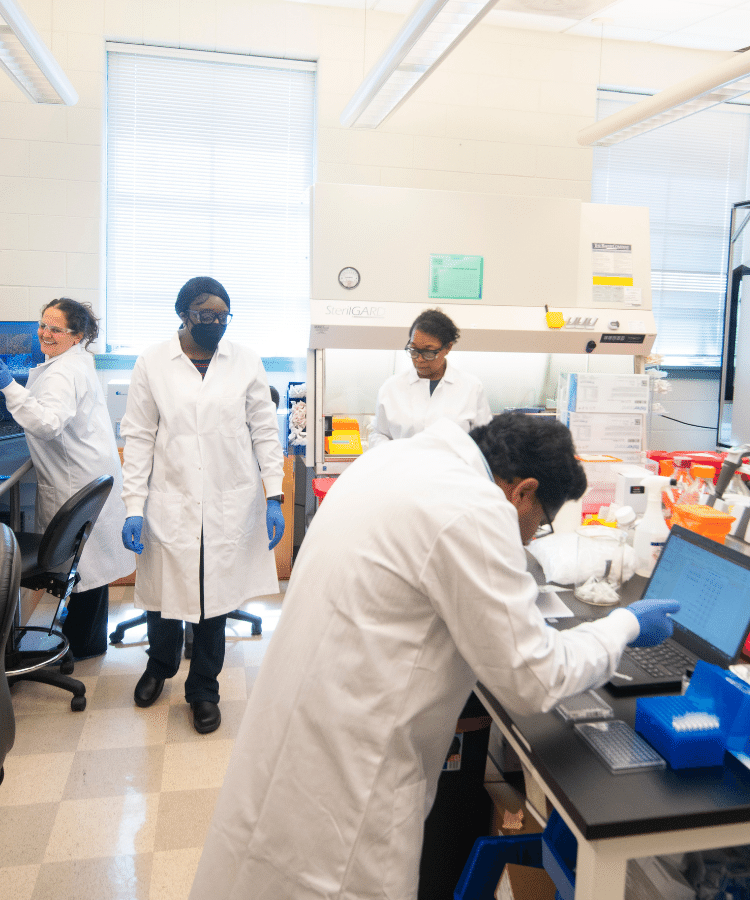
University of Georgia students work in the UGA Center for Applied Genetic Technologies